


Will Self-Clinching Nuts Deform After Installation? Here’s What Sheet Metal Fabricators Must Control
Self-clinching nuts are the backbone of high-volume sheet metal assembly — you press them once, and they lock permanently into place, ready to accept screws on the opposite side. But the moment a panel bows, a nut leans, or threads crush during installation, that promise of reliability vanishes. For purchasing managers and manufacturing engineers, understanding exactly why self-clinching nuts deform after installation is not just a quality concern; it’s a cost, delivery, and reputation issue.
This article translates lab data and field experience into actionable guidelines. You’ll see how material thickness, tooling setup, fastener material, and non-standard designs influence deformation. If you’re specifying clinch nuts for steel, aluminum, or stainless enclosures, this is your prevention checklist.
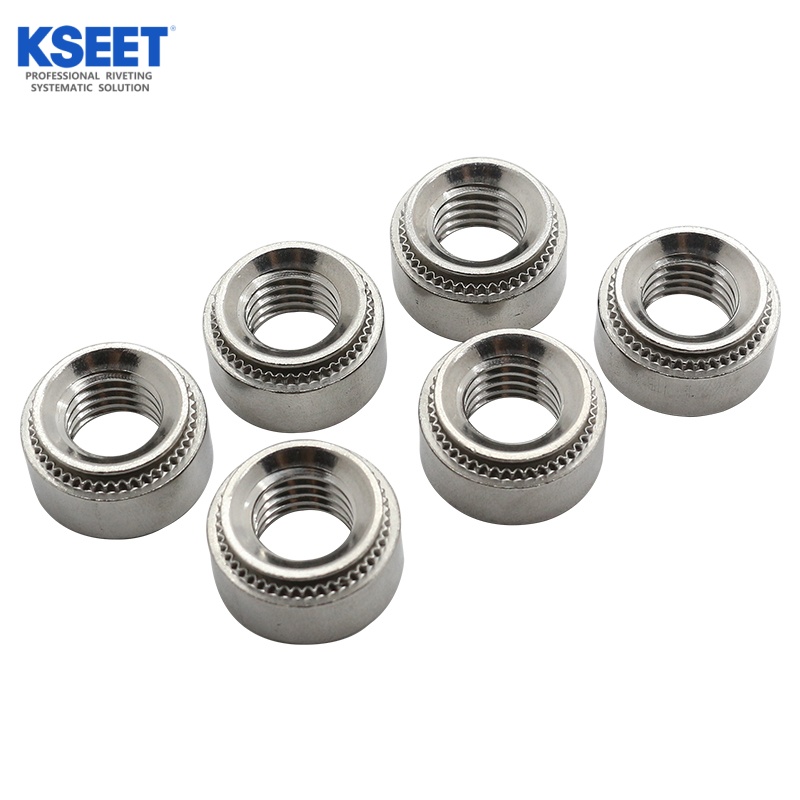
Material Thickness: The Non-Negotiable Foundation
Deformation almost always starts at the sheet. Self-clinching fasteners are designed for a specific grip range, and stepping outside that window causes two distinct failure modes:
-
Sheet thinner than 0.8 mm (e.g., 0.6 mm aluminum): During installation, the anvil force displaces the base material before the nut’s knurls can fully embed. The result is a visible dent, waviness around the hole, or even tearing. In severe cases, the nut fails to clinch and spins freely under assembly torque.
-
Sheet thicker than 3.0 mm (e.g., 4 mm mild steel): Here, the problem shifts. The panel itself rarely deforms because of its stiffness, but the installation load may be insufficient to fully embed the clinching ring into the thicker section. The nut sits proud, torque resistance drops, and the joint may loosen over vibration cycles — a hidden defect that passes visual inspection but fails in the field.
Action for buyers and engineers: Never assume a single nut series covers your entire product family. For a 1.5 mm aluminum enclosure, a standard M3 or M4 self-clinching nut works perfectly. But if the design also uses a 0.7 mm cover panel, you must switch to a thin-sheet type or reconsider the joint design entirely. Always cross-reference the fastener manufacturer’s minimum and maximum sheet thickness tables before releasing the BOM.
Installation Pressure and Tooling: Where Process Control Eliminates Deformation
Even with the correct fastener and sheet combination, the press setup determines whether you get a clean clinch or a rejected part. The three most common process-induced deformation patterns are:
-
Over-pressing – Applying force beyond the fastener’s design limit pushes the nut head below flush, creating a depression around the hole. In aluminum, this appears as a crater; in brushed stainless, it ruins the cosmetic finish. Besides aesthetics, over-compressing can fracture the nut’s hardened clinch ring, reducing push-out strength.
-
Off-center installation – If the punch and anvil are misaligned, or the sheet moves during the stroke, the nut tilts. One side embeds deeper, pulling the sheet into a local bow. The tilted thread axis then causes screw cross-threading during final assembly, leading to field returns.
-
Incorrect anvil geometry – Each clinch nut profile requires a matching anvil. Using a flat anvil on a nut designed for a contoured seat concentrates force at the edges, bending thin sheet around the fastener.
Engineering fix: Adopt a simple center-punch pre-load jig for manual operations, or move to CNC-controlled servo presses that monitor force-displacement curves. The press curve immediately shows if the sheet yielded correctly or if excess travel occurred. Train operators to recognize a good clinch — a slight, uniform witness mark around the nut head is acceptable and actually indicates full material flow. A raised rim, on the other hand, means the pressure was too low and the joint is suspect.
Fastener Material and Quality: Why Cheap Nuts Cost Panels
Not all “stainless steel” clinch nuts behave identically. Reputable self-clinching nuts use heat-treated carbon steel or 300-series stainless with controlled hardness. The nut is deliberately harder than the sheet so that it displaces the base metal without itself deforming. When a low-cost, uncertified fastener enters the supply chain, three things happen:
-
Nut body yielding: The fastener’s shank bulges under press force, splitting the surrounding sheet or creating a loose fit.
-
Thread collapse: During installation or first screw insertion, threads strip because the core hardness is below specification. This failure mode looks like installation deformation but is really a material defect.
-
Corrosion mismatch: Inferior plating or wrong stainless grade leads to galvanic corrosion, weakening the panel around the nut and eventually causing cracks that mimic mechanical deformation.
Recommendation for procurement: Specify internationally recognized standards (e.g., ISO 13918, ASME B18.29.2M) on your drawing and request mill test reports for critical lots. In safety-related assemblies — medical devices, EV power modules, aerospace brackets — a few cents saved per nut can result in a six-figure recall. When evaluating a new vendor, ask for their hardness test data on the clinching ring and thread, not just the bulk material certificate.
Acceptable Marking vs. Real Deformation: A Visual Inspection Guide
One of the most frequent questions we receive from quality departments is: “We see a ring mark around every installed nut. Is that a defect?” The answer: a light, even circular witness mark is the signature of a successful clinch. It proves the sheet metal flowed plastically into the nut’s undercut, creating a positive mechanical lock. This mark should be flush or only fractionally depressed — typically less than 0.1 mm on steel and 0.15 mm on aluminum.
You are looking at real deformation requiring rework when you find:
-
A depression deeper than 0.2 mm measured with a dial indicator.
-
Visible distortion on the opposite face of the panel (oil-canning).
-
Nut head tilted by more than 1 degree relative to the sheet surface.
-
Cracks radiating from the hole edge, indicating excessive work hardening or a punched hole with poor edge condition.
We advise fabricators to add these four checkpoints to their first-article inspection checklist. It catches process drift before thousands of panels are affected.
Non-Standard Clinch Nuts: Managing Customization Risk
Specialty applications — electric busbars, liquid-cooled cold plates, structural battery trays — increasingly require non-standard self-clinching nuts with extended shanks, unusual head diameters, or exotic materials. Deformation risk here multiplies because the standard installation parameters no longer apply.
For example, a stainless steel clinch nut with an oversized head designed for a 2 mm aluminum plate will require a different anvil contact area and reduced press speed to prevent the head edge from cutting into the sheet. Similarly, custom-length threads intended for thermal stack-ups may demand a stepped anvil that supports the panel while allowing full shank travel.
How to stay safe with non-standard fasteners:
-
Co-engineer the fastener and anvil geometry with your supplier before tooling release.
-
Run a Design of Experiments on 30–50 samples, varying pressure and dwell time to find the process window that delivers pull-out and torque-out values without sheet deformation.
-
Keep detailed setup sheets with press settings, and lock them at the machine when running production lots.
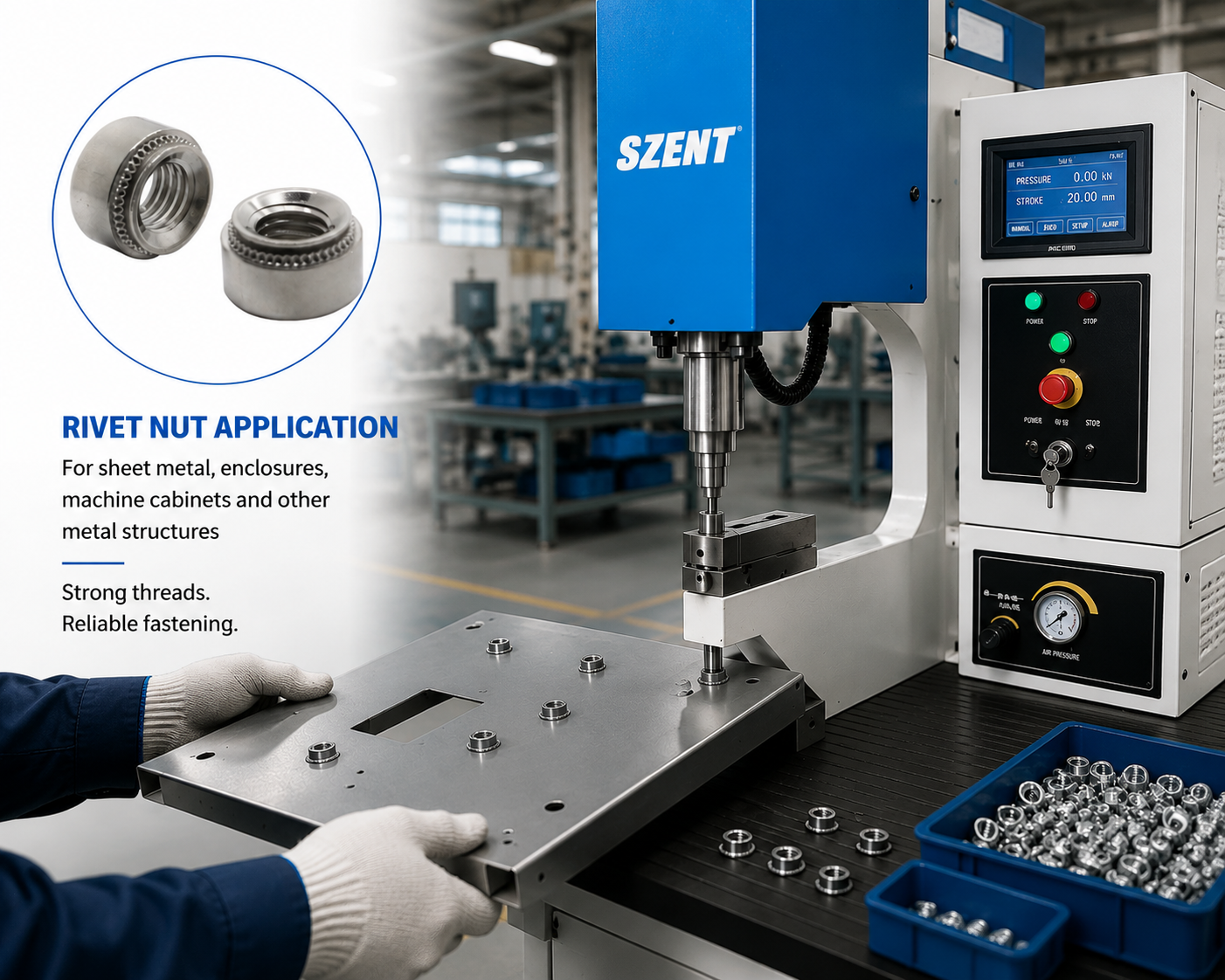
Daily Operations and Long-Term Joint Integrity
Deformation isn’t only an installation problem. After assembly, avoid applying prying loads directly to the clinch nut zone. In service, large off-axis loads can gradually loosen the joint and warp the panel. For enclosures subjected to vibration, consider adding a thread-locking feature or a secondary retaining compound as insurance.
Routine audits help, too. Assign a monthly check on random samples to measure nut push-out force and panel flatness. If you see a trend toward lower insertion depth or increased marking, revisit tooling wear and press calibration before it becomes a defect wave.
Turn Deformation Worries Into Zero-Defect Production
Preventing self-clinching nut deformation is a system-level discipline — one that starts with matching the nut series to the exact sheet thickness, continues with calibrated tooling and trained operators, and is validated by clear go/no-go visual and dimensional criteria. When these controls are in place, the clinch joint becomes one of the most repeatable and robust fastening methods in sheet metal fabrication, whether you’re building 500 server racks a day or 50 surgical robots a year.
Ready to remove the guesswork from your next assembly?
Request a complimentary sample kit matched to your panel material and thickness, or contact our application engineering team for a detailed installation review at your facility.
Engineer’s closing note:
The clinch fastener system achieves its rated performance only when the sheet, nut, and installation energy are in equilibrium. Control those three variables, and you control deformation — delivering a joint that withstands torque, push-out, and vibration without cosmetic or structural compromise. Verify your stack-up, lock your process, and audit periodically. That’s how Class-A surfaces and mission-critical joints stay intact.