


Why Self-Pierce Riveting Is the Go-To Fastening Method for Auto Body Repair and Beyond
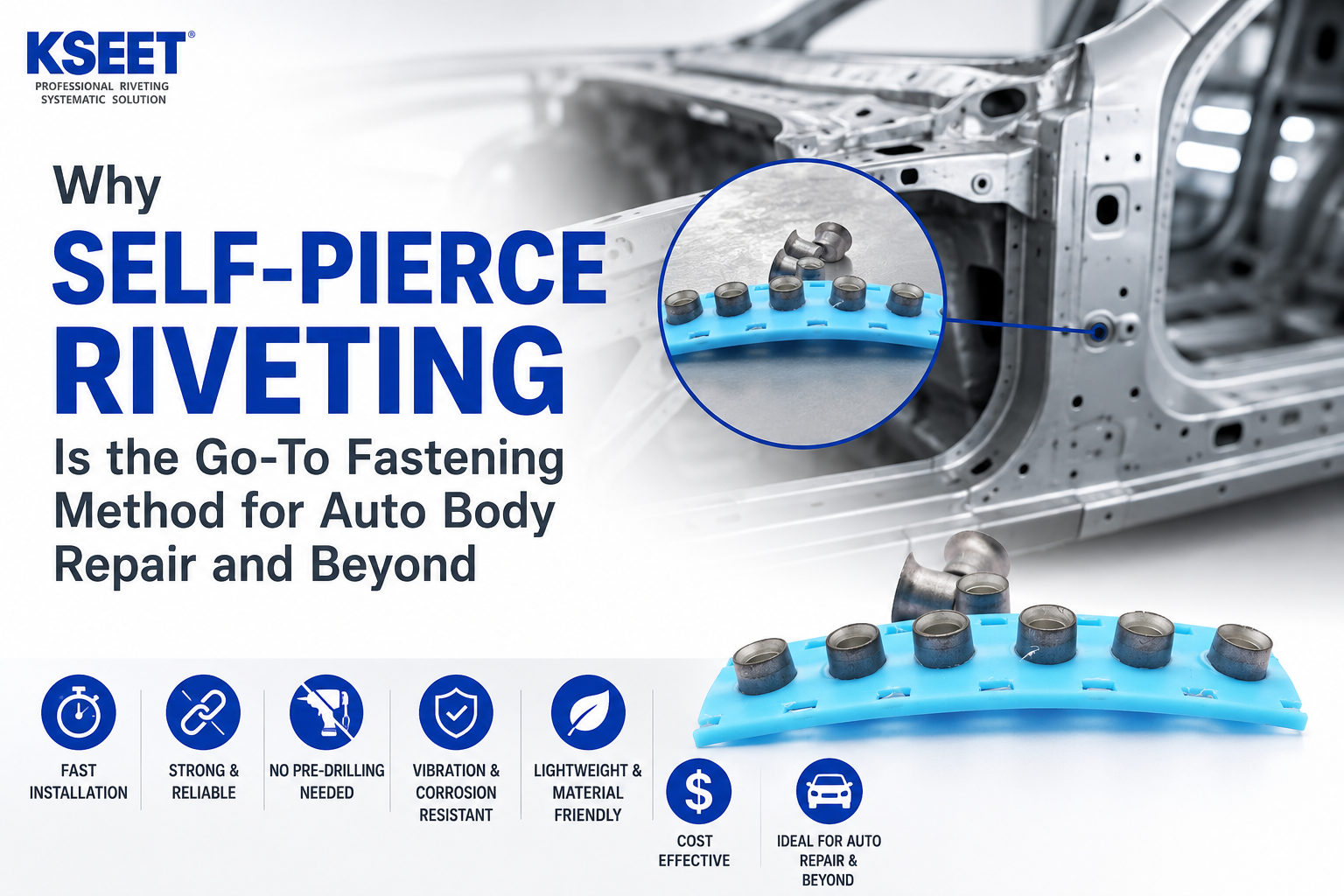 Understanding Self-Pierce Riveting Technology
Self-pierce riveting (SPR) is a high-speed mechanical fastening method that joins two or more sheets of material without the need for pre-drilled or punched holes. The process utilizes a semi-tubular rivet, typically steel with a flat head, driven into the sheet stack by a hydraulic punch. The rivet pierces the upper sheet and expands radially into the bottom sheet under the guidance of a shaped die, creating a strong mechanical interlock. Unlike conventional rivets that require aligned holes, SPR rivets form the hole during setting, cutting through the top layer and splaying inside the bottom layer without penetrating it. This cold-forming process produces a joint with high static strength and excellent fatigue resistance while completely avoiding the heat-affected zones, fumes, and spatter associated with resistance spot welding. In automotive body repair, where mixed material architectures are increasingly common—combining aluminum, advanced high-strength steel (AHSS), and coated mild steel—SPR has become the go-to joining technology prescribed by vehicle manufacturers for structural repair procedures.
Core Advantages of Self-Pierce Riveting
1. Joining of Dissimilar Materials
The single most compelling advantage of SPR technology in modern vehicle repair is its ability to reliably join dissimilar materials that are impossible or dangerous to weld. Directly welding aluminum to steel creates brittle intermetallic compounds and is prohibited by OEM repair guidelines. SPR rivets mechanically fasten these materials without metallurgical interaction, enabling collision shops to restore factory joints in aluminum-intensive bodies, steel-aluminum hybrid structures, and multi-material hang-on parts. This capability extends beyond automotive to appliance manufacturing, where stainless steel tubs are joined to galvanized steel frames, and to building panel fabrication involving aluminum to steel connections.
2. Zero Heat Distortion and Coating Preservation
Because SPR is a purely mechanical cold-forming process, it generates no thermal stresses, warping, or burn-through on thin panels. Anti-corrosion coatings, including zinc layers on galvanized steel and e-coat on replacement body panels, remain intact through the joining cycle. The absence of heat also eliminates post-weld straightening and re-coating steps, significantly reducing labor hours per repair. For body shops, this means consistent panel alignment and a dramatic reduction in paint preparation time on visible exterior surfaces.
3. No Pre-Drilled Holes – Process Efficiency
SPR rivets are self-piercing by definition; they eliminate the hole-drilling or punching step required by blind rivets and structural bolts. The rivet acts as its own punch, cutting the upper sheet and forming the interlock in a single stroke. This reduces assembly steps from three (clamp, drill, set) to one (clamp and set), accelerating repair throughput on production lines and in collision repair bays. Tooling integration with C-frame or handheld setting units allows access to flanges and hem joints that are inaccessible to conventional spot welding electrodes.
4. High-Strength, Airtight and Watertight Seals
The mechanical interlock produced by an SPR joint provides consistent tensile and shear strengths that are highly repeatable from joint to joint. Properly set rivets achieve load values that meet or exceed OEM spot weld specifications in many thin-gauge applications. Furthermore, the tight radial expansion of the rivet body against the hole walls, coupled with the bottom sheet material flowing around the rivet shank, creates an inherently weather-resistant seal that prevents moisture ingress. This is particularly important for exterior body panels such as door skins and roof joints where corrosion at the seam is a long-term durability concern.
5. Flat Head for Smooth, Aesthetic Finish
The flat head profile of automotive SPR rivets sits nearly flush with the top sheet surface, mimicking the appearance of an original spot weld after a minimal skim coat of filler. This reduces the volume of body filler required before block sanding and priming, saving materials and improving final finish quality. In visible areas such as door hems and wheel arch lips, the flat head enables a nearly invisible repair that passes post-repair inspection without extensive metal finishing.
Automotive Body Repair Applications
SPR rivets are purpose‑designed for structural and cosmetic body repair tasks where original spot welds must be duplicated without introducing thermal damage. Common applications include:
-
Door Skin Replacement: SPR replicates factory hem joints between the outer skin and inner frame, particularly on aluminum door assemblies found on Audi, Jaguar, Ford F-150, and Tesla models. The cold process prevents skin warping that would require excessive filler work.
-
Roof Panel and Quarter Panel Attachment: Full‑body side repairs often involve replacing adhesively bonded and spot‑welded roof panels. SPR combines with structural adhesives to achieve a hybrid joint that meets OEM fatigue and crash‑performance requirements.
-
Wheel Arch and Rear Body Panel Repairs: The tight access and multiple material layers in wheel housing areas make SPR ideal for duplicating factory joints where a spot welding electrode cannot physically reach.
-
Structural Rails and Reinforcement Brackets: On vehicles with mixed AHSS and aluminum front rails, SPR provides a certified joining method when sectioning or replacing structural components in accordance with vehicle maker repair procedures.
Collision repair professionals using SPR tooling must follow OEM‑specific rivet selection tables that dictate diameter, length, and coating based on the sheet stack thickness and material grades. Adhering to these guidelines ensures the repaired joint performs identically to the original factory connection in subsequent crash events.
Expanding into Other Industries
While automotive manufacturing and repair represent the dominant market for self-pierce riveting, the technology’s unique capabilities have driven adoption across several adjacent sectors:
-
Appliance Manufacturing: Washing machine drums, dryer cabinets, and refrigerator housings frequently require joining stainless steel to galvanized steel or aluminum. SPR eliminates the cosmetic defects and corrosion issues associated with resistance welding, while providing a clean interior surface free of fastener protrusions.
-
HVAC and Building Envelope: Aluminum curtain wall brackets, steel framing connectors, and insulated panel assemblies benefit from SPR’s one‑step fastening of dissimilar metals and coated materials. The weather‑tight joint reduces building envelope leakage points.
-
Rail and Mass Transit: Interior paneling, seat frames, and equipment cabinets in railcars use SPR to join lightweight aluminum components to stainless steel structures, meeting stringent fire‑safety and vibration‑resistance standards without welding fumes.
-
General Industrial Enclosures: Electrical cabinets, generator housings, and heavy equipment guards utilize self-piercing rivets to fasten steel panels to zinc‑plated frames where maintaining corrosion protection is critical and hot work permits are undesirable.
Technical Performance and Joint Quality
An SPR joint’s quality is evaluated by cross-sectioning a set sample and measuring three key geometric parameters: head height, interlock distance, and remaining bottom sheet thickness. These values must fall within a narrow process window defined by the rivet and die combination. Modern SPR setting tools record force‑displacement curves for every joint, enabling 100% in‑process monitoring and traceability that surpasses traditional spot weld quality assurance. Automotive OEMs and collision repair networks increasingly require this data to validate repair integrity.
Steel SPR rivets are available with zinc‑nickel or Geomet® coatings to match the corrosion protection requirements of the original panels. When joining aluminum sheets to steel rivets, a protective isolation strategy—such as an adhesive interlayer or zinc‑flake coated rivet—must be considered to prevent galvanic corrosion over the vehicle’s service life. Rivet selection should always follow the vehicle maker’s approved repair matrix, which correlates material grade, thickness, and stack sequence to the correct rivet part number.
Integration into the Body Shop Workflow
Switching from spot welding to self-pierce riveting requires an initial investment in tooling, but the long-term savings are substantial. A single SPR setting tool, whether a C‑frame unit for bench‑level assembly or a handheld electro‑hydraulic gun for on‑vehicle work, replaces multiple pieces of welding equipment, associated consumables (tips, gas, wire), and ventilation infrastructure. The learning curve is short, and joint quality is far less operator‑dependent than MIG plug welding, which demands precise heat control and torch angle discipline. Many shops report that technician proficiency on SPR is achieved within days rather than weeks, increasing repair bay throughput during peak collision seasons.
CTA Section
Equip Your Body Shop with SPR Rivets for Modern Collision Repair
We supply OEM‑equivalent self-piercing rivets in flat head configurations with the coatings and grip ranges required for late‑model vehicle repair. Our technical support team can assist with rivet selection, tooling compatibility, and cross‑section validation.
Engineering Note: When repairing any vehicle that incorporates aluminum or AHSS structural members, follow the vehicle manufacturer’s approved joining methods without exception. Self-pierce riveting is the only cold‑joining technology that consistently reproduces factory‑equivalent joint strength and corrosion protection in multi‑material body structures. We recommend maintaining a library of OEM repair procedure documents and qualifying your SPR joints through periodic cross‑section coupon analysis to ensure consistent interlock and bottom‑sheet thickness values remain within tolerance.