


Peel Type Aluminum Blind Rivets: A Superior Fastening Method for Soft and Thin Materials
Introduction: The Soft-Material Fastening Challenge
Design engineers and production managers across industries frequently encounter the same assembly dilemma: how to create a strong, permanent, one-sided joint in materials that are too soft, brittle, or thin to survive conventional fastening. Standard blind rivets generate significant radial expansion and a concentrated clamping load that, while beneficial for structural metals, can easily crush cellular foams, crack rigid plastics, tear through thin aluminum sheet, or pull straight out of fiberglass laminate. Weld nuts, self-tapping screws, and adhesives each introduce their own trade-offs in terms of access, durability, and process complexity. The peel type blind rivet, specifically its aluminum flower head variant, was engineered expressly to solve this class of fastening problems. By re‑distributing the installed load across an oversized blind-side footprint, it delivers a trustworthy, vibration-resistant joint without compromising the host material.
What Is a Peel Type Blind Rivet?
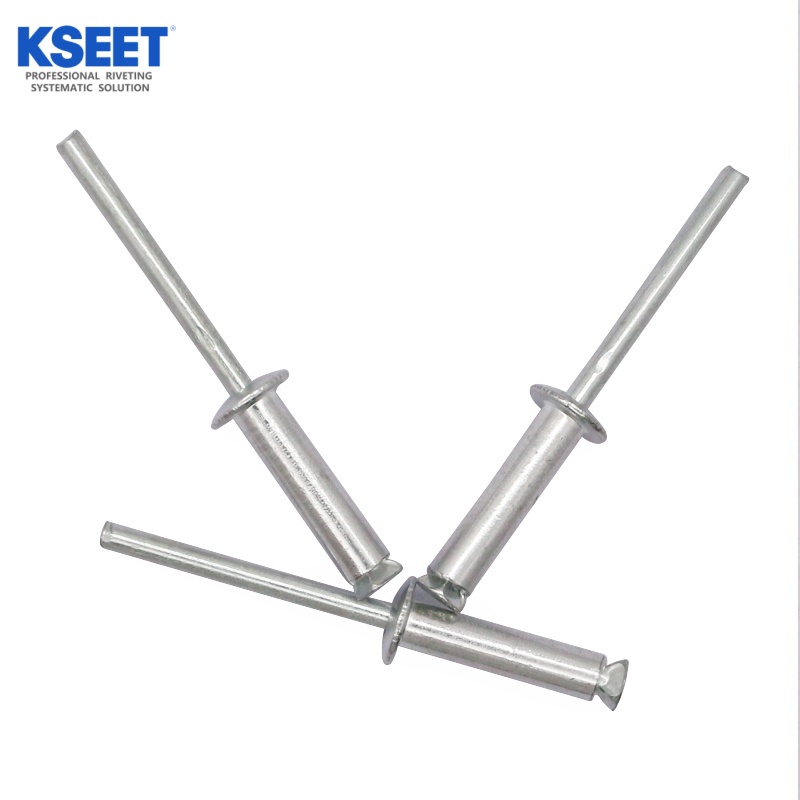
A peel type blind rivet, commonly referred to as a peel rivet, flower rivet, or split‑tail rivet, is a breakstem blind fastener designed to split and curl during setting. Like a standard pop rivet, it consists of two components: a hollow aluminum body and a steel or stainless steel mandrel. The critical difference lies in the body geometry. The blind end of the rivet body is pre‑cut with longitudinal slits, typically four, that function as predetermined fracture lines. When the setting tool pulls the mandrel, the body collapses not through uniform radial expansion, but by peeling open along these slits. The resulting four legs curl outward and back toward the joint, flattening against the rear sheet to form a broad, petal‑shaped anchor. Once the petals are fully set, the mandrel breaks flush with the dome head, leaving behind a secure mechanical lock.
This peel-open mechanism delivers two outcomes that standard blind rivets cannot replicate: an exceptionally large rear‑side load‑bearing surface and a clamping action that develops progressively rather than explosively, protecting the parent material throughout the installation cycle. The produced shape—resembling a flower—gives the fastener its common trade name, flower blind rivet.
Core Advantages of Aluminum Peel Type Blind Rivets
1. Unmatched Pull-Through Resistance in Soft Materials
The primary failure mode of a blind rivet installed in plastic, wood, or thin sheet is not rivet body fracture, but pull‑through: the entire fastener simply tears out of the base material under tensile load. A standard blind rivet’s blind-side bulge has a footprint only slightly larger than the drilled hole, concentrating stress on a small annulus. In contrast, the curled petals of a peel rivet contact the rear surface over an area that can be three to five times the nominal rivet diameter. This distributes clamping force broadly, keeping contact stress below the compressive yield point of materials such as ABS, polypropylene, acrylic, plywood, and thin‑gauge aluminum. For designers, this translates directly into a higher safety factor against pull‑out and the elimination of costly backup washers or reinforcing plates.
2. Material‑Friendly Setting Process
The petal curling action is inherently gentle. Instead of a sudden radial expansion that can crack brittle plastics or star‑crack painted surfaces, the peel rivet applies its clamping load gradually as the petals unfurl. The legs fold outward, away from the hole edge, so they do not exert hoop‑stress‑inducing expansion against the bore. This makes aluminum peel rivets the preferred blind fastener for painted, coated, or anodized sheets where surface damage must be avoided, and for brittle substrates such as acrylic display panels, polyester‑fiberglass laminates, and composite boards.
3. Vibration‑Resistant Aluminum Construction
The all‑aluminum body is naturally corrosion resistant and non‑magnetic, eliminating galvanic pairing concerns when fastening aluminum frames or when installed in outdoor environments. Once set, the petal legs contact the rear sheet across a compliant footprint that absorbs vibration energy, preventing loosening. In RV and trailer construction, where road‑induced vibration is a continuous load case, aluminum peel rivets maintain clamping force far more reliably than screws or standard pop rivets, reducing warranty claims associated with rattles and joint separation.
4. One‑Sided Installation with Standard Tooling
Peel type blind rivets are installed using the same manual, pneumatic‑hydraulic, or cordless rivet setting tools already present on most production floors. No specialized nosepiece is required beyond the standard one matched to the rivet diameter. The one‑sided access capability eliminates process steps such as flipping large panels or accessing the interior of closed box sections—directly reducing assembly labor and enabling designs that would be impractical or impossible with two‑sided fasteners.
5. Clean, Finished Appearance
The round dome head of the flower blind rivet presents a smooth, visually acceptable finish on the accessible side of the assembly. For consumer‑facing products such as furniture, point‑of‑sale displays, and electronic devices, this cosmetic advantage is real and immediate. There is no need for post‑installation head shaving, cap covering, or painting, which simplifies the bill of materials and streamlines final finishing.
Application Spectrum: Where Peel Rivets Outperform
The peel rivet’s ability to fasten materials that are too soft, brittle, or thin for standard blind rivets makes it a versatile workhorse across multiple industrial and commercial verticals.
-
Automotive and Recreational Vehicles: Interior door panels, dashboard assemblies, trim retention, headliners, and RV exterior skin attachment all benefit from the peel rivet’s ability to hold securely in plastic and thin aluminum without causing visible surface deformation. The vibration‑resistant joint also reduces in‑cabin squeaks and rattles.
-
Furniture and Cabinet Making: Knock‑down (KD) furniture, office partition systems, and upholstered seating rely on peel rivets to join thin steel or aluminum frames to plastic brackets and wood composite panels. The large bearing area prevents the fastener from pulling through particle board or MDF.
-
Signage and Display Construction: Aluminum panel‑to‑frame joints in outdoor signage, trade show exhibits, and retail fixtures use peel rivets to provide a corrosion‑resistant, tamper‑proof connection that won’t crack the acrylic or polycarbonate face sheets.
-
Electronics and Enclosure Assembly: Server racks, control cabinets, and instrument chassis frequently require fastening sheet metal to plastic mounting rails or cable guides. Peel rivets create a permanent joint without stressing the plastic component, and the non‑magnetic aluminum body avoids interference with sensitive electronics.
-
Marine and Outdoor Equipment: Aluminum peel rivets are a natural fit for boat trim, dock hardware, and outdoor furniture where both corrosion resistance and the ability to fasten fiberglass or plastic components are essential. For aggressive marine environments, stainless‑steel‑mandrel variants are available on request.