


1. Understanding the Blind Sealing Plugs Rivet – More Than a Blind Rivet
A Blind Sealing Plugs Rivet is a closed-end structural blind rivet whose fundamental innovation lies in a completely sealed tail end integrated with a sealing boss or ring. After setting, it forms a solid, closed plug at the blind side. This marks a critical difference from standard open-end breakstem rivets, which leave a hollow body that can act as an oil or vapor leak path. The sealing plug rivet employs a multi-barrier design to completely lock media out of the joint.
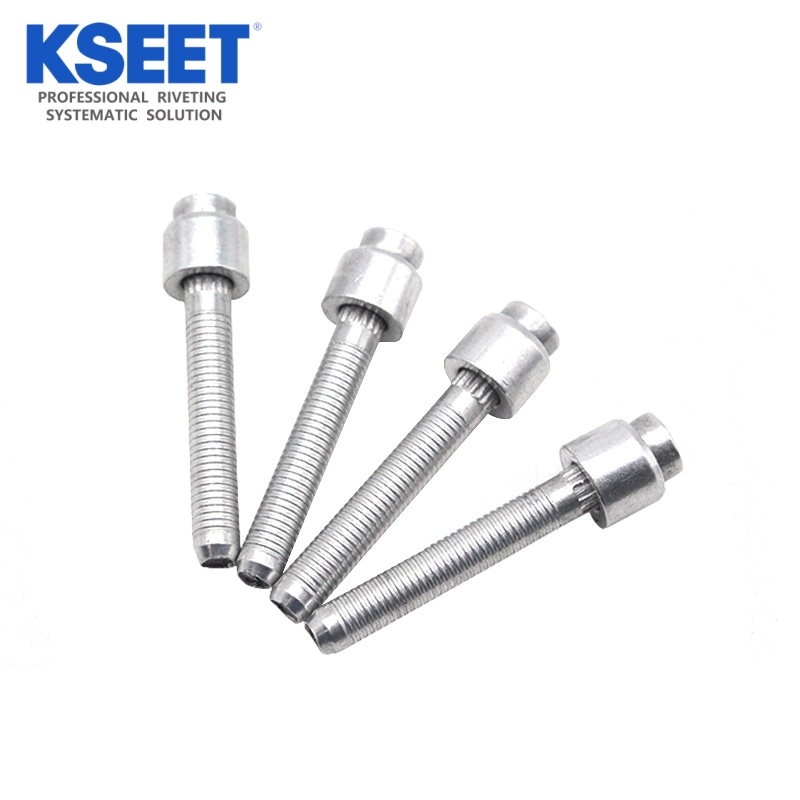
Key structural elements typically include:
-
Sealed rivet body: Manufactured from 10B21 carbon steel or 304/316 stainless steel, the body incorporates an integral sealing flange or a groove for an O-ring.
-
Closed expansion tail: During setting, the tail expands and fills the workpiece chamfer or countersink, creating a metal-to-metal hard seal at the blind side.
-
Breakneck mandrel: Precision-engineered with a locking collar or mechanical lock, the mandrel breaks flush at a controlled force, and the retained mandrel head does not rattle or loosen.
2. Four Key Selection Factors – Specifying the Correct Part Based on Operating Conditions
Selection errors in engine cover applications can lead to premature seal degradation or even rivet joint fracture. Always validate these four critical factors:
1. Base Material Compatibility and Galvanic Corrosion
Typical engine cover materials include high-pressure die-cast aluminum (ADC12, AlSi9Cu3), with the mating side being cast iron or a plastic cam cover. Incompatible rivet material can trigger severe galvanic corrosion under salt spray and hot-wet conditions. Recommendation: for aluminum covers, use aluminum rivets with a stainless mandrel, or zinc-nickel alloy coated carbon steel rivets (e.g., SZENT Zn-Ni plating exceeding 720 h to red rust). For cast iron applications, stainless steel sealing plug rivets are preferred. Never use uncoated carbon steel in direct contact with aluminum.
2. Hole Diameter and Grip Range
The sealing plug rivet must match the recommended hole size precisely. For instance, the SZENT BSR series requires a mounting hole of Ø4.1 ±0.05 mm with a grip range of 1.5–4.0 mm. When a rubber-coated steel gasket or compression sealing strip is present, the grip range must be calculated after subtracting gasket compression to avoid under-compression or excessive squeeze.
3. Temperature and Media Resistance
On the exhaust side of a turbocharged engine, local peak temperatures at the timing cover can reach 200°C or higher. In such cases, FKM (fluoroelastomer) O-ring variants or fully metallic copper-seal designs are mandatory. Standard configurations typically cover -40°C to 150°C using NBR or ACM seals; high-temperature custom versions are available up to 230°C.
4. Mechanical Performance – Shear and Tensile Strength
A sealing rivet must not only seal but also withstand shear and pull-out forces from engine block vibration and crankcase pressure pulses. As an example, a SZENT Ø4.8 mm stainless steel sealing plug rivet guarantees a minimum shear strength of 1500 N and tensile strength of 2200 N. Design should maintain a safety factor of at least 1.5. In FEA simulation, sealing rivets can be modeled as multi-point constraints, with careful evaluation of hole-edge stress to avoid base material cracking.
3. Assembly Process and Quality Assurance – The Key to Consistent Sealing
Even with the correct component selection, flawed installation will lead directly to seal failure. Unlike standard blind rivets, the installation of sealing plug rivets demands rigorous control over several process stages:
3.1 Installation Tool Selection
A pneumatic-hydraulic or servo riveting tool with break force monitoring and stroke control is strongly recommended. For M4 and M5 sealing plug rivets, the setting force typically ranges from 8 to 15 kN. Hammer-driven or low-precision manual tools must be avoided, as uneven mandrel break or insufficient pulling force will destroy the sealing flange. SZENT supplies dedicated nose assemblies and pulling heads matched to each rivet type to ensure axial alignment.
3.2 Setting Process Parameters
Based on SZENT engineering standards, critical parameters include:
-
Pre-contact force: 30–50 N to ensure full flange seating.
-
Pulling stroke speed: 20–40 mm/s. Slower speeds cause heat build-up; faster speeds risk displacing the sealing ring.
-
Final hold time: 0.5–1.0 s to ensure adequate plastic flow and hole-wall filling.
3.3 Mounting Hole Preparation
Hole surface roughness must be Ra ≤3.2 μm. The hole entrance requires a 0.3–0.5 ×45° chamfer, fully deburred. The sealing plug rivet achieves primary sealing through an annular line contact between the flange and the chamfer. Poor hole quality creates a "bell-mouth" condition, leading to oil weepage.
3.4 In-Process Inspection
First-off and last-off samples each shift must be checked for:
-
Expanded tail diameter after setting (minimum 1.4 times the original body diameter).
-
Sealing flange compression: verify clearance between flange and workpiece surface is less than 0.05 mm using a feeler gauge.
-
Leak test: perform online or offline pneumatic testing at 50–100 kPa with an acceptance leakage rate <1 cc/min.
4. Common Field Failure Modes and Countermeasures
Drawing from long-term field support, three high-frequency failure modes are summarized:
Failure 1: Protruding Mandrel Break Residue Causing Interference or Seal Failure
Root cause: insufficient break force or worn nose piece causing the mandrel to break outside the designated groove. Countermeasure: specify sealing plug rivets with "flush break" design. SZENT series rivets maintain a residual mandrel height ≤0.2 mm after breaking.
Failure 2: Low-Temperature Cold Start Oil Leak
Root cause: seal ring material loses resilience below -30°C, or differential contraction between an aluminum rivet and a steel cylinder head. Countermeasure: adopt rivets with a compensating spring washer or switch to an all-metal sealing rivet. Alternatively, fluorosilicone seal rings can extend low-temperature capability down to -60°C.
Failure 3: Micro-Cracks Around the Hole
Root cause: excessive interference, hydrogen embrittlement of the rivet material, or insufficient edge distance from the hole to the cover edge. Countermeasure: increase edge distance to at least 2× hole diameter, ensure rivet hardness is lower than the base material, and use dehydrogenation-treated plating.
5. Long-Term Sealing Validation – From Bench Test to Field Durability
After OEMs and Tier-1 suppliers adopt blind sealing plugs rivets, a typical validation sequence includes:
-
Thermal shock cycling: -40°C to 150°C, 1000 cycles, followed by leak check.
-
Vibration durability: random vibration 15–2000 Hz, 20 hours per axis on three axes, acceleration ≥10 Grms.
-
Engine dynamometer test: 3000 hours of alternating load conditions, followed by re-inspection for axial residual force (since sealing rivets do not rely on torque, clamp integrity is assessed via residual tension).
Data demonstrates that engine cover assemblies employing high-quality sealing plug rivets achieve a sealing life 2–3 times greater than traditional bolt-plus-gasket designs, while reducing cover weight by 60–100 g and cutting assembly cycle time by over 40%.
Engineering Conclusion
The value of the Blind Sealing Plugs Rivet extends beyond its function as a fastener—it redefines the sealing logic of engine covers by integrating "sealing" and "fastening" into a single inseparable system. Only rigorous data-driven control at every step, from parameter selection and tool calibration to process capability management, can deliver the 10-year / 300,000 km leak-free durability that modern powertrains demand. The SZENT engineering team strongly recommends joint simulation and physical sample setting prior to design freeze to mitigate series production risk to the greatest extent possible.
📩 CTA (Call to Action)
Request Sample / Contact Us
Looking for high-strength fastening solutions for trucks, trailers, or engineering machinery?
👉 Contact SZENT for:
- Ring Grooved Rivets & Lockbolt Systems
- Installation Tools & Technical Support
- OEM & ODM Manufacturing
- Fast Global Delivery
📧 Email: sales@szenttools.com
🌐 Website: www.szenttools.com